

In this current situation, websites and mobile applications are more than just business tools; they’re the face of your organization. From banks and e-commerce platforms to government portals and corporate websites, these applications are where interactions happen, transactions are processed, and data flows every second. But with this visibility and functionality comes a growing vulnerability.
Cybercriminals aren’t just targeting systems anymore; they’re going straight for the web apps. It’s high time to concentrate on how to secure web applications effectively. And that’s where the Web Application Firewall (WAF) comes in. One of the most effective ways to secure web applications is through a Web Application Firewall (WAF).
What Is a Web Application Firewall (WAF)?
Let’s keep it simple. A Web Application Firewall (WAF) is like a security checkpoint for your web apps. A Web Application Firewall acts as a security guard between the web app and the Internet. It sits between your website (or app) and the outside world, inspecting every request that comes in and every response that goes out. Its job? Identify and block malicious activity before it even reaches your systems. It identifies, monitors, filters, and blocks malicious activity and traffic from the application before it reaches your systems.
Unlike traditional firewalls that focus on network-level protection, WAFs look deep into web traffic content. They can recognize suspicious behaviors, malicious code, or attack patterns and act instantly to stop them. WAFs focus specifically on HTTP/S traffic, where most attacks against web apps occur. They help prevent many threats, from SQL injection and cross-site scripting (XSS) to more advanced and targeted attacks.
How Does a Web Application Firewall Work?
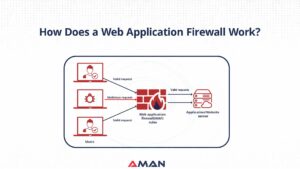
At its core, a Web Application Firewall (WAF) sits between a web application and the end user, acting as an intelligent filter for incoming and outgoing traffic. It inspects HTTP and HTTPS requests in real time, using a combination of predefined rules, behavior analysis, and threat intelligence to determine whether the traffic is safe or potentially harmful.
WAFs operate on Layer 7 of the OSI model (the application layer), where they can analyze traffic content, not just packet headers, giving them deep visibility into malicious payloads hidden within legitimate requests. For instance, if a hacker attempts an SQL injection attack by inserting harmful code into a form submission field, the WAF recognizes the signature of this pattern and blocks the request before it reaches the server.
Depending on the deployment model, cloud-based, on-premises, or hybrid, a WAF can be configured to operate in passive (monitoring only) or active (blocking) mode. Most modern WAFs also use machine learning to adapt to new threats, automatically adjusting rulesets based on unusual traffic patterns or emerging vulnerabilities. Ultimately, the WAF’s job is to inspect every request and response to ensure your applications behave as expected and that attackers stay locked out.
How WAF Shields Your Web Assets
Your web applications are often the most vulnerable aspect and exposed part of your IT infrastructure, and attackers are aware of this. This is where a Web Application Firewall (WAF) becomes invaluable. It not only blocks malicious IP addresses or known blacklisted URLs, but it also actively safeguards your web-based platforms by monitoring and mitigating a wide array of attacks.
A well-configured WAF guards against:
- Injection attacks like SQL injection and command injection that try to manipulate your server-side logic.
- Cross-site scripting (XSS) which can inject malicious scripts into your web pages to target users.
- File inclusion attacks, where attackers try to gain access to internal files or execute malicious code on the server.
- Session hijacking, cookie tampering, and protocol abuse.
The power of a WAF lies in its adaptability. As your application evolves adding new features, handling more user data, or integrating with third-party APIs your WAF evolves with it. Whether your app is deployed on a cloud platform, hosted on-premises, or spread across multiple environments, WAFs today are built to scale with your business.
Most importantly, a WAF reduces the burden on your development and security teams. Instead of rewriting application code to address every vulnerability, you can implement security policies within the WAF to enforce protection at the gateway level. This not only accelerates deployment cycles but also gives you peace of mind that your digital assets are shielded, even if attackers find a new door to knock on.
Why Every Organization Needs WAF Today
Many organizations still think cybersecurity ends at antivirus or network protection. But attackers know the real value lies in your apps and the data they handle. And that’s where they strike. Web applications often stand at the forefront of cyberattacks due to their accessibility. From e-commerce platforms to internal employee portals, any web-connected service can be exploited. A Web Application Firewall (WAF) provides a proactive layer of defense by stopping these attacks at the edge before they reach your server. Without a WAF, your organization may remain unaware of malicious activity until after a breach occurs. For industries like finance, healthcare, education, and government in Saudi Arabia, the cost of a breach is more than financial. It’s a matter of trust.
By implementing a WAF, organizations gain control, visibility, and peace of mind. In today’s digital-first economy, not having a WAF is like leaving your office unlocked overnight; it’s not just risky, it’s irresponsible.
Beyond Protection: WAF’s Operational Benefits
In recent years, national regulators like NCA (National Cybersecurity Authority) and SAMA have raised the bar for security compliance. As part of Vision 2030’s drive for digital excellence, protecting digital assets is a shared responsibility across both public and private sectors.
Having a Web Application Firewall (WAF) in place doesn’t just help meet these expectations, it helps organizations stay resilient in the face of growing cyber threats. Implementing a Web Application Firewall isn’t just about stopping attacks. It also helps businesses run more efficiently. By filtering out malicious and unwanted traffic, WAFs reduce server load and improve application performance. They also help with regulatory compliance, which can prevent fines and enhance your organization’s credibility.
Moreover, having a WAF in place builds customer confidence. In a region where digital trust is becoming a deciding factor for consumers and clients, security isn’t a back-office function it’s a business driver.
Why Choose AMAN’s Web Application Firewall?
Here’s where our difference becomes clear. At AMAN Solutions for Cyber Security, we don’t believe in one-size-fits-all products. As part of our Mobile and Web App security service, we provide Web Application Firewall (WAF) as a managed service, tailored to each organization’s real-world environment and threat exposure.




Pingback: Mobile App Shielding: What It Is and Why It Matters - Aman